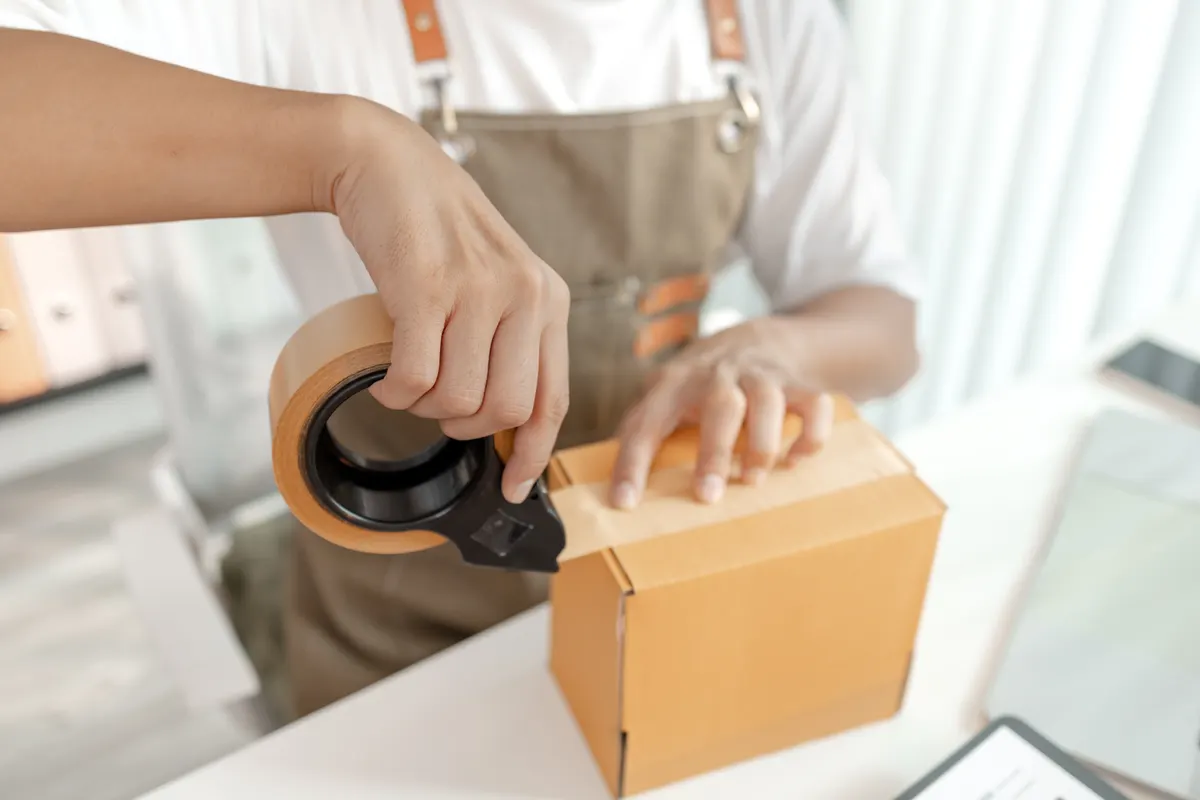
Packaging is the only thing your store sends that the customer opens with both hands. No inbox, no feed, no other tab. For thirty seconds they are handling your product with full attention, and whatever is in the box is the only voice in the room.
Stores spend that moment on a logo. Sometimes on a coupon for a discount the customer did not need to be given. Almost never on the two things that actually decide whether there is a second order: does the product work as expected, and is buying it again obvious.
We treat packaging as part of the repeat-purchase lever, not part of the brand budget. That changes the questions. Not what does the box look like, but what does the box have to do. It has to get the product there undamaged, get the customer using it correctly, make a return painless if it comes to that, and leave a path back to the store that does not depend on the customer remembering your name.
Delivery is the first moment your store is real
Until the parcel arrives, your store is a website and a card charge. The delivery is when it becomes a physical thing with a smell, a weight and a quality of finish.
That is why the box carries more weight than its cost suggests. A product that arrives loose in an oversized carton, with a cracked lid or a crushed corner, has already told the customer something about how much care goes into the operation. It does not matter that the courier caused it. The customer bought from you.
This is also the moment where expectation meets reality on quality. A well-made product in careless packaging reads as cheaper than it is. A modest product in considered packaging reads as more careful than it is. You are not fooling anyone either way, you are setting the frame the customer uses to judge what they just paid for.
So the first packaging decision is not aesthetic. It is whether the item arrives in the condition the product page implied. Damage in transit is a return, a refund, a support ticket and usually a lost customer, all from a component that costs less than the shipping label.
The box is the only message from your store that a customer opens with both hands.
Protection is a retention feature, not a cost line
Look at your damage and defect returns before you look at anything else in this article. If items arrive broken, bent, leaking or scuffed, every other packaging idea is decoration on top of a problem.
The fixes are ordinary. Right-sized cartons so contents do not move. Void fill that suits the weight rather than whatever came with the last order. Corner protection on anything rigid. Liquid seals that survive being tipped. A second layer for anything glass. Cold chain that holds through the slowest service you offer, not the fastest.
The test is cheap: send parcels to your own address using each shipping service you sell, including the slow one, and open them the way a customer would. Do it seasonally, because couriers change handling and your supplier may have quietly changed a component.
The economics favour spending here. A damaged order costs you the product, the outbound shipping, the return handling if you collect it, the replacement, the support time and the review. Set against that, a better carton is one of the few costs that pays for itself in a single avoided incident.
Give the insert one job
Most inserts try to do four things at once and achieve none. They carry a thank-you message, a social handle, a discount code, a referral offer and a hashtag, printed small enough that the customer puts the card down without reading it.
Pick one job. For a consumable, that job is usually the reorder path: what this is, how long it lasts, and how to get more without hunting for the site. For anything with a learning curve, the job is instructions, because a product used correctly is a product bought again. For a considered purchase, the job might be the care information that protects the item and the customer's opinion of it.
Write it in plain language and print it large enough to read without glasses. If you need more space than a card, put a short link or code on the card and a proper page behind it, then keep that page current.
A discount code is the weakest option and the most common. It offers money off a second purchase the customer has not decided to make, and it teaches them that your prices are negotiable. If you want to include one, put it behind the useful content, not in place of it.
Make the return as easy as the order
This sounds like the opposite of a retention idea. It is not. The customer who returns an item easily and politely is a customer who will risk ordering from you again. The customer who fights a return is gone, and they tell people.
So design the packaging so it can be reused. A carton that survives one opening is a small barrier that turns into a support ticket. Resealable tape or a second adhesive strip costs very little. A returns note that says plainly what to do, with the address or the label process, saves an email.
The same applies to exchanges. If a customer's most likely problem is size or fit, the fastest route back to a sale is an exchange they can start without contacting anyone. Packaging that supports that, by being reusable and by carrying clear instructions, converts a refund into a second attempt.
While you are there, check what the return experience does to the customer's opinion. If the item has to go back in three separate pieces of protective material that were destroyed on opening, the return is going to arrive damaged and someone is going to be unhappy about it. That is a packaging design problem, not a customer problem.
Cost it against the second order, not the first
Packaging decisions get made against the cost of one order, which is why they are usually made downwards. Judged against the value of the next order, the same numbers look different.
Here is a worked example with invented figures. Say your average order is 50 dollars, gross margin is 45 percent, so 22.50 dollars an order. You take 600 orders a month. Improving the insert and the carton costs an extra 40 cents an order, which is 240 dollars a month.
For that to pay for itself, you need about eleven extra repeat orders a month, or roughly two extra second orders per hundred customers. Whether that is plausible depends on your product, but it is a far smaller ask than the ad spend you would need to buy eleven new customers.
Run the same three lines with your numbers before you decide packaging is expensive. And run it again on the damage side: work out what a damaged order costs you all in, then ask how many damaged orders the better carton has to prevent.
The point is not that expensive packaging is always right. It is that packaging is an investment in the second order, and it should be judged on that timeline.
If you change one thing this quarter
Change the insert, because it is the cheapest to test and the easiest to reverse.
Write one card that does the single most useful thing for your product. For a consumable, that is how to store it, how long it lasts, and the shortest route to reordering. For anything assembled, it is the step people get wrong. For anything worn, it is care and sizing. Print it, ship it with every order for a period long enough to cover your typical reorder gap, and compare the repeat rate for those customers against the period before.
While that runs, order your own product on your slowest shipping service and open it on camera. You will find things no supplier sample shows you: the tape that tears the print, the void fill that spills, the card that arrives face down under the product where nobody will see it.
Then make the change permanent or drop it. Packaging is one of the few areas where a small, cheap, reversible change reaches every single customer you have, which is exactly the kind of work that belongs early in a plan rather than in the section labelled brand.