Personalized products ecommerce marketing agency
Growth plans for print and personalization stores: personalizer conversion, production lead times, gifting deadlines and reorders on saved artwork.
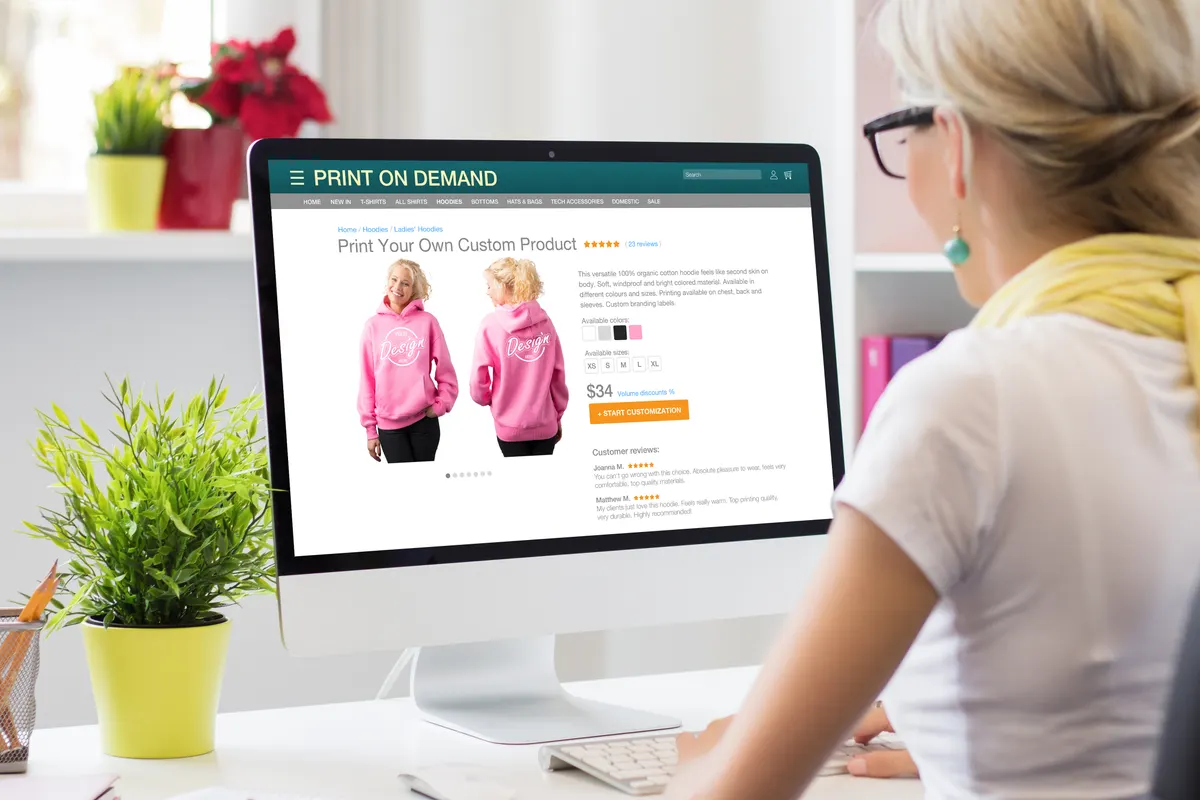
How a personalized product is bought
Personalized products are sold and made in the wrong order. The customer pays first, then the item is printed, engraved, bound or cut to their file, their name, their date. That single fact reshapes the marketing. The product page has to work as a design tool and not only as a sales page. The delivery promise has to carry production days as well as shipping days. And the generous return policy that reassures shoppers everywhere else is the one thing you cannot offer, because nobody else wants a mug with a stranger's dog on it.
We write growth plans for print and personalization businesses that already sell online. That includes print-on-demand studios, photo book services, trade printers, sticker and label makers, engravers, sign shops and gift stores. The plan covers the four numbers behind revenue, visitors, conversion rate, average order value and repeat purchases, and it is written against your production capacity, your artwork requirements and your calendar of gifting deadlines. It costs nothing until you decide to go ahead with the work.
Below are the fourteen niches in this industry that we write for separately. A wedding invitation store and a site hoarding printer both put ink on a substrate, and that is roughly where the similarity ends.
The order arrives before the product exists. Every business in this industry shares that, and it reorders the whole funnel.
The shopper does more work here than in any other category. They pick a base product, then they type a name, upload a photo, choose a font, approve a proof or lay out sixty pages in a book builder. Each of those steps is a place to give up. The stores that grow are usually the ones that made the configuration step faster and clearer, not the ones that bought more traffic.
Trust rests on two promises: it will look right, and it will arrive in time. It will look right is answered by a live preview, a digital proof, a photograph of a real finished item rather than a flat render, and a plain statement of what gets printed if the customer types their name in lower case. It will arrive in time is answered by separating production days from shipping days, saying both out loud, and holding an order-by date you publish and keep.
The return policy is the third difference. In the UK and EU, goods made to a consumer's specification or clearly personalized are generally exempt from the standard cancellation right, and in practice a resale item with a stranger's initials has no second buyer. So the store has to prevent the wrong order rather than absorb it, with spelling confirmations, proof approvals and file checks before anything runs.
Occasions drive the year. Christmas, Valentine's Day, Mother's Day, Father's Day, graduations, weddings and birthdays each pull a different part of a personalized catalog, and the demand arrives against a deadline rather than across a season.
The four levers
in print & personalized
Where revenue usually leaks in this industry.
Visitors
Visitors: win the searches that carry an occasion or a spec
Demand in this industry splits in two. Gift buyers search by recipient and occasion, such as personalized gifts for dad or custom name necklace for a girlfriend. Spec buyers search by material, size and quantity, such as waterproof vinyl stickers 500 or A5 dated planner refill. Those need different pages, different feed titles and different campaigns. We map your catalog against both kinds of query, then rebuild titles, collections and ad structure so the base product, the personalization and the spec are all findable.
Conversion rate
Conversion: the personalizer is the checkout
Most lost revenue in personalized ecommerce happens between add to cart and the design being approved. Uploads fail on phone photos, character limits truncate a name without warning, previews render in a font nobody chose, and proofs sit in an inbox unopened for days. We test the configuration flow on a phone the way a customer uses it, fix the upload and preview steps, put production time and the order-by date next to the button, and add the spelling confirmation that stops the reprint before it happens.
Average order
Order value: the upgrade, the second item and the quantity break
A personalized order grows in three ways. The upgrade sells a better substrate, a frame, a gift box or a faster turnaround. The second item puts the same design on a matching product, which costs you almost nothing because the artwork already exists. The quantity break rewards a bigger run on printed goods where your unit cost falls anyway. We look at what your customers already add, then build the modules and the price tiers so the choice is obvious at the right moment.
Repeat purchases
Repeat purchases: saved designs and the next occasion
Repeat buying here is unusually easy to earn because the hard part is done. The customer's file, name spelling and proof are already in your system. A saved design library with a one click reorder turns a fifteen minute job into a thirty second one. On top of that sit the calendars: the annual photo book, the next year's planner, the label reorder when a small brand runs out, the birthday you can remind them about. We build the flows around whichever cycle your order data actually shows.
14 kinds of
print & personalized store
Each one written for that store's reality.
- Calendar & wall art marketing agencyHow calendars and wall art are actually chosen
- Custom apparel marketing agencyHow a custom apparel order comes together
- Custom pet portrait marketing agencyHow a pet portrait is commissioned
- Custom printing marketing agencyHow business print is bought
- Engraved gift marketing agencyHow an engraved gift is chosen
- Greeting card marketing agencyHow greeting cards are bought online
- Personalized gift marketing agencyHow a personalized gift is chosen
- Phone case marketing agencyHow a printed phone case is bought
- Photo book & print marketing agencyHow a photo book order actually happens
- Print-on-demand art marketing agencyHow wall art is chosen when it is printed to order
- Sign & banner marketing agencyHow signage is specified and bought
- Stationery & planner marketing agencyHow planners and stationery are chosen
- Sticker & label marketing agencyHow stickers and labels are bought
- Wedding invitation marketing agencyHow a couple buys wedding stationery
Questions from print & personalized brands
Send your print & personalized store.
The plan is written for your store, in your niche, as it is today.